Conventional Loan Requirements: How to Qualify
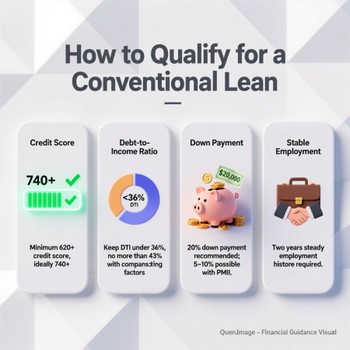 A conventional loan gives qualified borrowers some of the best interest rates and most flexible terms in today's mortgage market. Because conventional loans are not insured by a federal agency — unlike FHA or VA mortgages — lenders set their own qualification standards to manage risk. That means your credit score, income stability, debt load, and available assets all get scrutinized before an underwriter signs off.
Understanding the requirements for a conventional loan before you apply lets you fix problems early, present a stronger file, and lock a better rate. This guide covers every major qualification factor lenders review in 2026.
What Is a Conventional Loan?
A conventional loan is a mortgage not guaranteed or insured by the federal government. These loans follow guidelines established by Fannie Mae and Freddie Mac — the government-sponsored enterprises that buy mortgages from lenders on the secondary market — which is why lenders can offer them at competitive rates with consistent underwriting standards.
Conventional loans come in two main categories:
- Conforming Loans: Meet Fannie Mae and Freddie Mac guidelines, including loan amount limits
- Non-Conforming Loans: Exceed standard loan limits (jumbo loans) or fall outside other conventional criteria
Most buyers work with conforming conventional loans, which offer the most competitive rates and the widest lender availability.
Credit Score Requirements for Conventional Loans
Your credit score is the first thing lenders look at. It determines your interest rate tier and, in many cases, whether you qualify at all. Review the minimum credit score requirements for conventional loans before you apply.
Minimum Credit Score Standards
- Absolute Minimum: 620 credit score (required by most lenders)
- Competitive Rates: 680–700 credit score
- Best Rates and Terms: 740+ credit score
- Excellent Tier: 760+ credit score
While 620 is the entry point, borrowers at that floor pay noticeably higher rates. Each 20-point improvement in your score can lower your rate by roughly 0.25% to 0.50%, which adds up to thousands of dollars over a 30-year loan.
See the full breakdown of conventional loan credit requirements.
How Credit Score Affects Your Interest Rate
- 760+: Lowest available rates, maximum lender competition
- 740–759: Near-optimal rates with excellent terms
- 720–739: Competitive rates, strong approval odds
- 700–719: Slightly higher rates, solid approval chances
- 680–699: Moderately higher rates, additional scrutiny
- 660–679: Noticeably higher rates, stricter requirements
- 640–659: Significantly higher rates, limited lender options
- 620–639: Highest conventional rates, minimal lender availability
How to Improve Your Credit Score Before Applying
- Pay Down Credit Card Balances: Keep utilization below 30%; below 10% is better
- Make Every Payment on Time: Payment history is 35% of your credit score
- Hold Off on New Credit Applications: Multiple hard inquiries temporarily lower your score
- Dispute Credit Report Errors: Incorrect information can unfairly drag scores down
- Become an Authorized User: Piggyback on a family member's strong credit history
- Pay Off Collections: Settling old debts can move the needle over time
If you need a faster fix, ask your loan officer about a rapid rescore. Allow 3–6 months for most credit improvement strategies to register before applying.
Down Payment Requirements
Conventional loans allow down payments as low as 3%, but putting more down reduces your rate and eliminates or shortens private mortgage insurance.
Standard Down Payment Options
- 3% Down: Available to first-time homebuyers and qualifying borrowers through HomeReady and Home Possible programs
- 5% Down: Standard low-down-payment option for most borrowers
- 10% Down: Reduces PMI costs compared to 5% down
- 15% Down: Further PMI reduction with better rate options
- 20% Down: Eliminates PMI entirely; qualifies for best rates
See all 3% down conventional loan programs and the 97% LTV conventional loan option.
Private Mortgage Insurance (PMI)
When you put down less than 20%, lenders require private mortgage insurance. PMI typically costs 0.3% to 1.5% of the original loan amount annually, based on your credit score, down payment percentage, and loan-to-value ratio.
Once your loan balance reaches 80% of the home's original value, you can request PMI removal. At 78% LTV, lenders must cancel PMI automatically if you are current on payments. Learn exactly when private mortgage insurance goes away.
Alternatively, some borrowers use lender-paid mortgage insurance (LPMI), trading a slightly higher rate for no separate PMI payment, or a piggyback loan strategy to avoid PMI altogether. Use our conventional loan down payment calculator to run the numbers on your situation.
Acceptable Down Payment Sources
- Personal Savings: Most straightforward and least scrutinized
- Gift Funds: From family members with proper documentation — see gift money for a house
- Grants and Assistance Programs: Down payment assistance for qualifying buyers
- Retirement Accounts: 401(k) loans or IRA withdrawals (penalties may apply)
- Sale of Assets: Stocks, bonds, or other property
- Employer Assistance: Some employers offer homebuyer assistance programs
Gift funds require a signed letter confirming the money is not a loan, plus donor bank statements showing the funds came from a legitimate source.
Income and Employment Requirements
Stable, verifiable income is non-negotiable. Lenders need documented proof that your income is sufficient and likely to continue.
Employment History Standards
- Minimum Requirement: Two years of consistent employment history
- Ideal Scenario: Same employer or industry for 2+ years
- Recent Job Changes: Acceptable if within the same field with equal or higher income
- Self-Employment: Two-year minimum with consistent net income
- Employment Gaps: Explainable gaps (education, medical leave) may be acceptable with documentation
Lenders verify employment by contacting your employer directly and typically request written verification, your last 30 days of pay stubs, and W-2s from the past two years. Self-employed borrowers must provide two years of tax returns. See the full conventional loan income requirements.
Income Verification by Borrower Type
W-2 Employees Need:
- Last two years of W-2 forms
- Most recent 30 days of pay stubs
- Two years of federal tax returns (if claiming additional income sources)
- Year-to-date profit and loss statement if income has increased
Self-Employed Borrowers Need:
- Two years of personal federal tax returns (all schedules)
- Two years of business tax returns (if applicable)
- Year-to-date profit and loss statement
- Balance sheet showing business assets and liabilities
- CPA-prepared statements (strongly recommended)
Additional Income Sources Lenders Can Count:
- Bonuses (with 2-year history, averaged over 24 months)
- Commissions (averaged over 2 years)
- Overtime pay (if consistent)
- Rental income (75% of gross rents)
- Investment income (dividends, interest)
- Social Security benefits
- Pension or retirement income
- Alimony or child support (with court documentation)
- Disability payments
Debt-to-Income Ratio Requirements
Your debt-to-income ratio — total monthly debt obligations divided by gross monthly income — is the single number lenders use to judge whether you can carry a mortgage on top of existing obligations.
How DTI Is Calculated
- Front-End Ratio (Housing Ratio): Proposed housing expenses ÷ Gross monthly income
- Back-End Ratio (Total Debt Ratio): All monthly debts ÷ Gross monthly income
Lenders focus on the back-end ratio, which includes the proposed mortgage payment (principal, interest, taxes, and insurance), HOA dues, PMI, plus all recurring debts: car loans, student loans, credit card minimums, personal loans, and alimony or child support.
Use our debt-to-income calculator to find out where you stand before you apply.
Maximum DTI Standards
- Ideal DTI: 36% or lower — strongest approval odds and best rates
- Standard Maximum: 43% back-end ratio
- High Credit Score Exception: Up to 45% with a 740+ credit score
- Maximum with Compensating Factors: Up to 50% in rare cases
Full guidelines at conventional loan DTI ratio requirements.
How to Lower Your DTI Before Applying
- Pay Down Debt: Eliminate credit card balances and close out smaller installment loans
- Add a Co-Borrower: A second income can immediately improve your qualifying ratio
- Avoid New Debt: Hold off on car purchases or any new credit before and during the application
- Target a Lower Purchase Price: A smaller loan means a smaller monthly payment
- Document All Income Sources: Additional income you haven't listed can move the number
Asset and Reserve Requirements
Beyond the down payment, lenders want to see liquid reserves — cash left over after closing that shows you can handle a hardship without defaulting immediately.
Minimum Reserve Standards
- Primary Residence: 2 months of PITI (principal, interest, taxes, insurance)
- Second Home: 4 months of PITI — see conventional loan for second home
- Investment Property: 6 months of PITI — see investment property loan requirements
- Multiple Properties: Additional reserves required for each property owned
Acceptable reserve assets include checking and savings accounts, money market accounts, CDs, mutual funds, stocks and bonds (typically counted at 70% of value), and retirement accounts (counted at 60–70% of vested balance).
Not acceptable: unsecured borrowed funds, cash with no paper trail, gift funds beyond down payment and closing costs, unvested stock options.
Large Deposit Scrutiny
Lenders review bank statements carefully. Any deposit exceeding 25% of your monthly income requires documentation of its source. Keep clear records for all major financial transactions during the mortgage process. More on showing bank statements for a mortgage.
Property Type and Loan-to-Value Considerations
The property you buy affects your rate, down payment, and reserve requirements.
Property Classifications
- Primary Residence: Lowest interest rates, most flexible qualification standards, widest range of loan programs
- Second Home / Vacation Property: Rates typically 0.125%–0.375% higher than primary; must be at least 50 miles from primary residence; cannot produce rental income; stricter reserve requirements
- Investment Property: Rates typically 0.5%–0.75% higher than primary; higher down payment required; rental income can offset the mortgage payment in DTI calculations; see minimum down payment for a second home conventional loan
Use our LTV/CLTV calculator to determine your loan-to-value ratio.
Property Condition Requirements
Conventional loans require the property to be structurally sound, with all major systems (plumbing, electrical, HVAC) functional, no health or safety hazards, adequate access and utilities, and compliance with local building codes. Properties needing major work may not qualify and might need a renovation loan or a cash purchase followed by refinancing. See home inspection requirements for conventional loans.
Types of Conventional Loans
Fixed-Rate Mortgages
Fixed-rate mortgages lock your interest rate for the life of the loan, so your principal and interest payment never changes. Common terms:
- 30-Year Fixed: Lowest monthly payment, highest total interest paid
- 25-Year Fixed: Moderate payments, good middle ground
- 20-Year Fixed: Higher payment, meaningful interest savings
- 15-Year Fixed: Highest payment, lowest total interest cost
- 10-Year Fixed: Aggressive payoff with minimal interest
The 30-year fixed remains the most popular choice for its balance of affordability and equity-building. Calculate your options with our conventional loan monthly payment calculator.
Adjustable-Rate Mortgages (ARMs)
ARMs start with a fixed rate for an initial period, then adjust annually based on a market index. Common structures:
- 5/1 ARM: Fixed for 5 years, adjusts annually
- 7/1 ARM: Fixed for 7 years, adjusts annually
- 3/1 ARM: Fixed for 3 years, adjusts annually
ARMs offer lower initial rates than fixed-rate loans, which appeals to buyers who plan to sell or refinance before the adjustment period begins. Rate caps limit how much the rate can move at each adjustment and over the life of the loan.
High-Balance and Jumbo Loans
When your loan amount exceeds conforming limits, you move into high-balance or jumbo territory with stricter qualification standards.
2026 Conforming Loan Limits:
- Standard limit: $832,750 (most U.S. counties)
- High-cost areas: Up to $1,249,125
Jumbo Loan Requirements:
- Credit score typically 700+ minimum, 740+ preferred
- Maximum DTI usually 43% or lower
- Down payment typically 20% minimum
- Reserves of 6–12 months
- More thorough documentation throughout
Special Conventional Loan Programs
HomeReady Loan Program (Fannie Mae)
HomeReady targets low-to-moderate income borrowers and first-time buyers with relaxed requirements and reduced mortgage insurance costs.
- 3% down payment minimum
- Income limits apply (typically 80% of area median income)
- Flexible income sources, including non-occupant co-borrower income
- Homebuyer education required
Compare HomeReady vs FHA and HomeReady vs Home Possible.
Home Possible Loan Program (Freddie Mac)
Home Possible offers similar benefits with slight variations in income limit structure and credit flexibility.
- 3% down payment minimum
- Income limits in most areas
- Lower mortgage insurance premiums
- Well-suited to first-time and low-income buyers
97% LTV Conventional Loan (Conventional 97)
Standard 97% LTV financing requires just 3% down with no income restrictions.
- At least one borrower must be a first-time homebuyer
- Property must be single-family or owner-occupied 1-unit condo
- 680+ credit score recommended
- Standard reserves and DTI requirements apply
Compare Conventional 97 vs FHA to determine which program fits your situation.
Documentation Checklist
Having your documents organized before you apply speeds underwriting and reduces the chance of last-minute delays. Full list at required documents for a conventional loan.
All Borrowers Need
Identity: Government-issued photo ID, Social Security card or verification, proof of current residence.
Income: Last 30 days of pay stubs, W-2s from the past 2 years, federal tax returns from the past 2 years, year-to-date profit and loss statement.
Assets: Last 2–3 months of bank statements (all pages), investment and retirement account statements, documentation for other significant assets.
Credit History: Explanation letters for any derogatory marks, bankruptcy discharge papers if applicable, divorce decree or separation agreement if applicable.
Self-Employed Borrowers Also Need
- Two years of personal tax returns (all schedules)
- Two years of business tax returns (all schedules)
- Business license
- Articles of incorporation or partnership agreement
- Year-to-date profit and loss statement
- Business bank statements (last 2–3 months)
- CPA letter verifying self-employment
Property Documents
- Purchase agreement or sales contract
- Property listing
- HOA documents (if applicable)
- Property appraisal (ordered by lender)
- Homeowners insurance quote
- Property tax information
The Conventional Loan Application Process
Step 1: Pre-Qualification
Pre-qualification is an informal estimate based on self-reported information. It takes minutes and gives you a ballpark loan amount, but it carries no weight with sellers and is not a commitment from the lender.
Step 2: Pre-Approval
Pre-approval requires actual documentation and credit verification. The lender issues a conditional approval letter specifying your maximum loan amount, estimated rate, expiration date, and remaining conditions. Pre-approval strengthens your offer and gives you a realistic price range. Start with conventional loan prequalification. Most initial pre-approvals take 1–3 days; full underwriting review can take up to 10.
Step 3: Home Shopping and Offer
With pre-approval in hand, you can shop with confidence. When you find the right property, your offer should include your price, earnest money deposit (use our earnest money calculator), financing and appraisal contingencies, and proposed closing date.
Step 4: Full Application and Processing
After offer acceptance, your loan processor orders the appraisal, verifies employment and income, obtains the title search, and collects any additional documentation needed. Processing typically takes 7–14 days.
Step 5: Underwriting
The underwriter reviews your complete file through the automated underwriting system and manually verifies income stability, asset adequacy, credit history, and property value. They may issue conditions — requests for additional documents or written explanations — before issuing final approval. Initial underwriting takes 2–7 days; conditions add time.
Step 6: Clear to Close
Once all conditions are satisfied, you receive "clear to close" status. The lender prepares closing documents and coordinates with the title company.
Step 7: Closing
Do a final walkthrough to confirm the property is in agreed-upon condition. At closing, you sign loan documents, pay closing costs, and receive your keys. Most conventional loans close in 30–45 days from application. See how fast a conventional loan can close.
Common Reasons for Conventional Loan Denial
Credit Issues
- Credit score below the lender's minimum
- Recent foreclosure, bankruptcy, or short sale within the required waiting period — see getting a conventional loan after Chapter 7
- Too many recent hard inquiries
- High credit utilization
- Unpaid collections or charge-offs
Income and Employment Problems
- Income too low to support the proposed payment
- Unexplained employment gaps or frequent job changes
- Declining income trend on tax returns (especially for self-employed borrowers)
- Missing or inconsistent income documentation
Asset and Down Payment Problems
- Insufficient funds for down payment and closing costs
- Large deposits without documented sources
- Down payment funds that are actually loans
- Insufficient liquid reserves after closing
DTI Problems
- Back-end ratio exceeds lender threshold
- Undisclosed debts appearing on the credit report
- New credit opened during the application period
- Co-signed loans increasing your effective debt load
Property Problems
- Appraisal comes in below the purchase price
- Property doesn't meet minimum condition standards
- Property type restrictions (manufactured homes, co-ops, unusual structures)
- Title defects — liens, boundary disputes, ownership questions
How to Improve Your Approval Odds
Start 6–12 Months Early
Use the lead time to pull your credit reports and dispute any errors, pay down balances, build reserves, and research lenders and programs that fit your profile.
Keep Your Financial Picture Stable During the Process
Once you apply: do not change jobs, make large purchases, open new credit accounts, make unexplained deposits, close existing credit accounts, or miss any payments. Lenders re-verify your employment and credit shortly before closing — any significant change can delay or kill the transaction.
Compare Multiple Lenders
Rates and fees vary meaningfully across banks, credit unions, mortgage companies, online lenders, and brokers. Use our mortgage program comparison calculator and payment comparison calculator to evaluate your options before choosing.
Work with Experienced Professionals
- Real Estate Agent: Familiar with financing contingencies and the local market
- Loan Officer: Specializes in your buyer profile — first-time buyer, investor, self-employed
- Tax Professional: Can advise on income documentation strategy, especially for self-employed borrowers
Conventional Loan vs. Other Mortgage Types
Conventional vs. FHA Loans
FHA requires a 580 credit score with 3.5% down (or 500 with 10% down), compared to conventional's 620 minimum and 3% down. The major trade-off: FHA mortgage insurance stays for the life of the loan if you put 3.5% down, while conventional PMI can be removed at 80% LTV. Borrowers with credit scores above 680 and at least 5% down typically save money with a conventional loan over time.
Compare conventional vs. FHA and pros and cons of FHA vs conventional.
Conventional vs. VA Loans
VA loans are available only to eligible veterans, active military, and qualifying surviving spouses. They require no down payment and carry no PMI — a significant financial advantage for those who qualify. Conventional loans have no eligibility restrictions and more loan program variety. Learn how to hold both a conventional and an FHA loan simultaneously.
Conventional vs. USDA Loans
USDA loans require no down payment but restrict eligible properties to approved rural and suburban areas and cap borrower income. Conventional loans have no location or income restrictions, making them the only option for many urban and higher-income buyers.
Frequently Asked Questions About Qualifying for a Conventional Loan
Can I qualify for a conventional loan with student loan debt?
Yes. Student loans do not automatically disqualify you. Lenders include student loan payments in your DTI calculation. If loans are in deferment or forbearance, lenders use either 0.5% of the outstanding balance per month or the actual documented payment amount — whichever applies. Income-driven repayment plans with low monthly payments can significantly improve your qualifying ratios.Can self-employed borrowers qualify for a conventional loan?
Yes, though the documentation bar is higher. Lenders average two years of net income after business deductions from your tax returns. Minimizing deductions the year before applying, maintaining clean separation between business and personal finances, and building larger reserves all help your case. A CPA-prepared profit and loss statement adds credibility to your file.How long after Chapter 7 bankruptcy can I get a conventional loan?
The standard waiting period is 4 years from discharge. With documented extenuating circumstances, some lenders approve after 2 years. Chapter 13 requires a 2-year wait from discharge or 4 years from the filing date. See the full breakdown: conventional loan after Chapter 7 and how long after Chapter 7.Do I need perfect credit to qualify for a conventional loan?
No. Borrowers with scores as low as 620 can qualify. You do not need perfect credit — you need consistent payment history, reasonable utilization, limited recent inquiries, and written explanations for any derogatory marks. Higher scores get better rates, but 620 is a real entry point, not a theoretical one.Can I use gift money for my conventional loan down payment?
Yes. Gift funds from family members are acceptable for down payment and closing costs. Requirements: a signed gift letter stating no repayment is expected, the donor's bank statement showing the funds were available, documentation of the transfer, and verification of the relationship between donor and recipient. Full details at gift money for a house.What happens if my appraisal comes in below the purchase price?
You have several options: negotiate a lower purchase price with the seller, increase your down payment to cover the gap while maintaining the required LTV, challenge the appraisal with comparable sales data, request a second appraisal (lender-permitting), or walk away using your appraisal contingency. The appraisal contingency in your purchase contract exists specifically to protect you in this situation.Can my first mortgage be on an investment property?
Yes, though the requirements are materially stricter. Expect a credit score minimum of 700+, a down payment of 20–25%, at least 6 months of PITI reserves, and a higher interest rate than you would pay on a primary residence. See buying an investment property with a conventional loan.Maintaining Your Loan Status After Approval
Approval is not the finish line. Lenders re-verify employment status, run a soft credit pull, and confirm bank balances within days of closing. During this window, do not change jobs, take on new debt, open or close credit accounts, make large unexplained deposits, or miss any payments. Any of those actions can trigger re-underwriting or an outright denial before you get your keys.
Building Long-Term Financial Success After You Close
Qualifying is the beginning. Keep 3–6 months of expenses in liquid savings, budget for property taxes, insurance, maintenance, and HOA costs, and understand how your mortgage escrow account works. Making extra principal payments when possible accelerates equity — use our amortization calculator with extra payments to see the impact.
If rates fall or your credit score improves significantly post-closing, explore refinancing options including cash-out refinance, conventional cash-out limits, and the Fannie Mae RefiNow program.
Summary: What Lenders Actually Check
Qualifying for a conventional loan comes down to five categories: credit (620+ score, clean recent history), down payment (3%–20% depending on program and goals), income (two-year employment history, fully documented), DTI (ideally under 43%), and reserves (2+ months PITI after closing). Strong performance in any one category can compensate for weakness in another — a 760 credit score can offset a higher DTI; large reserves can offset a lower score.
Start by pulling your credit, running your DTI through our debt-to-income calculator, and identifying the weakest point in your file. Fix that first. Then compare lenders, get pre-approved, and apply with complete documentation ready to go. Review the pros and cons of a conventional loan and browse our conventional loan questions page for additional guidance.
Connect With Us
Please share – it really helps