Conventional Loan Monthly Payment Calculator
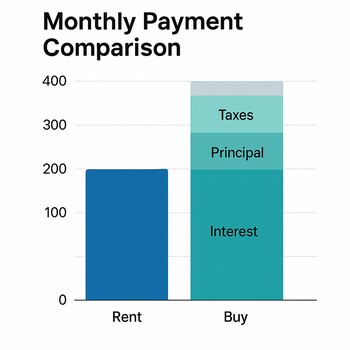 Your monthly mortgage payment determines affordability. But that single number masks complexity — it actually comprises principal, interest, taxes, insurance, and possibly PMI. Understanding each component and how they interact is the key to finding a loan that truly fits your financial situation. Use our conventional loan monthly payment calculator to see the full picture.
Many buyers focus only on the interest rate or the down payment percentage, missing opportunities to save tens of thousands of dollars over time. With the right calculation and strategy, you can optimize your mortgage for both short-term cash flow and long-term wealth building.
Use our free payment calculator now to see your exact monthly costs, or continue reading to understand how each component works and what payment strategies can save you the most money.
What Is Included in Your Monthly Payment (PITI)?
Mortgage professionals use the acronym PITI to describe the four core components that make up your standard monthly payment. For conventional loans, understanding each piece helps you negotiate better terms and spot savings opportunities.
Principal: Paying Down What You Borrowed
The principal is the amount you actually borrowed. If you took out a $300,000 loan, the principal balance starts at $300,000. Each month, a portion of your payment reduces this balance.
Early in your loan, the principal portion is surprisingly small — sometimes just a few hundred dollars on a $300,000 loan. As you approach payoff, the principal portion grows substantially, eventually comprising most of your payment. This front-loaded interest structure is why extra principal payments early in the loan term have dramatic impact on total interest paid.
Interest: The Cost of Borrowing
Interest is the lender's fee, calculated as a percentage of your outstanding balance. When your balance is highest, the interest portion of your payment peaks. Over time, as you pay down principal, monthly interest charges decrease.
This is why making extra principal payments early creates a snowball effect. Reducing the balance when it's largest saves interest across the entire remaining term. A single extra $10,000 payment in year 1 saves far more than an extra $10,000 payment in year 25.
Taxes: Property Tax Escrow
Lenders collect property taxes monthly and hold funds in an escrow account. When your tax bill arrives, the lender pays it automatically. This protects lenders from tax liens and guarantees the local government gets paid.
Property tax rates vary dramatically by location. A $300,000 home in one county might have $300/month in taxes, while the same home in a neighboring county could have $500/month. Location is a major driver of your total payment.
Insurance: Protecting Your Asset
Lenders require homeowners insurance and usually collect premiums through escrow. This protects your home's structure and your belongings from fire, theft, and other covered events.
Depending on your location and down payment, you may need additional coverage:
-
Private Mortgage Insurance (PMI): Required if your down payment is under 20%. PMI can be removed once you reach 20% equity. Learn how PMI affects your payment.
-
Flood Insurance: Required in FEMA-designated high-risk flood zones.
-
Earthquake Insurance: May be required in earthquake-prone regions, particularly California and the Pacific Northwest.
If your property is in an HOA, include HOA fees in your total housing costs when evaluating affordability.
How to Use a Conventional Loan Payment Calculator Effectively
A payment calculator is far more than a curiosity — it's a tactical planning tool. By inputting different scenarios, you can test your true budget before contacting a lender.
Key Inputs You Need
-
Loan Amount: Home price minus down payment. Explore different down payment levels to see the impact on your monthly payment and PMI costs.
-
Interest Rate: The rate you expect to be charged. Rates fluctuate based on your credit score and market conditions.
-
Loan Term: Typically 15 or 30 years. See the comparison section below for trade-offs between terms.
-
Property Taxes: Look up the annual rate for your target area and divide by 12.
-
Homeowners Insurance Quote: Get specific quotes from an insurance agent.
-
PMI Estimate: If down payment is under 20%, estimate 0.5% of loan amount ÷ 12 for monthly PMI.
Understanding Your Results
A quality calculator shows you the complete breakdown. You'll see exactly how much goes to principal, interest, taxes, insurance, and PMI each month. This clarity helps you spot opportunities:
- High taxes? Look for homes in areas with lower property tax rates.
- PMI costs significant? Consider saving for a larger down payment.
- Interest portion too large? Model a shorter loan term or extra principal payments.
15-Year vs. 30-Year Mortgage: A Clear Comparison
Your loan term choice shapes your entire financial picture. The 30-year mortgage is most popular because it offers lower monthly payments, but the 15-year term builds wealth faster and costs far less in total interest.
| Loan Term | Monthly Payment (Estimate) | Aggregate Interest Paid (Estimate) | Best For |
|---|---|---|---|
| 30-Year Fixed | Lower | Higher (~$200k+ on $300k loan) | Budget flexibility; lower monthly obligation |
| 15-Year Fixed | Higher (~40% more) | Much Lower (~$100k+ on $300k loan) | Faster equity building; substantial interest savings |
The math is stark: On a $300,000 loan at 6.5%, a 30-year mortgage costs roughly $382,000 in total interest. The same loan on a 15-year term costs only $180,000 — a savings of over $200,000. The trade-off is a monthly payment roughly 40% higher.
Choose a 30-year term if you prioritize monthly cash flow and flexibility. Choose 15-year if you can afford the payment and want to build substantial wealth faster.
Payment Strategies to Save Tens of Thousands
Beyond the standard monthly payment, proven strategies can dramatically reduce your interest and accelerate equity building. These methods turn your mortgage into a wealth-building engine.
The Bi-Weekly Mortgage Payment Strategy
Paying half your monthly payment every two weeks instead of once per month creates a powerful effect: you make 13 full payments per year instead of 12. That single extra payment each year goes entirely to principal, creating cascading savings.
The Math: How 26 Payments Beat 24
Example with a $2,000 monthly payment:
- Monthly Plan: 12 × $2,000 = $24,000/year
- Bi-Weekly Plan: 26 × $1,000 = $26,000/year
- Extra Annual Principal: $2,000 (one full payment)
Real Savings Examples
$300,000 mortgage at 6.5% interest:
- Monthly Plan: 30 years, $382,633 total interest
- Bi-Weekly Plan: 25 years 2 months, $284,803 total interest
- Your Savings: $97,830 in interest + nearly 5 years shorter loan
$500,000 mortgage at 7% interest:
- Monthly Plan: 30 years, $698,757 total interest
- Bi-Weekly Plan: 24 years 8 months, $517,392 total interest
- Your Savings: $181,365 in interest + over 5 years shorter loan
Advantages & Drawbacks
| Advantages | Drawbacks & Considerations |
|---|---|
| Massive Interest Savings: Easily $50k–$200k depending on loan size | Requires Higher Annual Cash Flow: Need $26k/year instead of $24k |
| Faster Equity Building: Own more of your home sooner | Reduced Liquidity: Money is locked in your home |
| Forced Savings Discipline: Automatic commitment to building wealth | Opportunity Cost: Money might earn more if invested elsewhere |
| Years Off Your Loan: Be mortgage-free 4–5 years earlier | Lender Fees: Formal programs may charge setup fees |
How to Start (DIY Method - No Fees)
You don't need a formal program to benefit from bi-weekly payments:
- Method 1: Add 1/12 of your payment to each monthly payment (pay $2,167 instead of $2,000).
- Method 2: Make one extra full payment once per year, applied directly to principal.
Verify with your lender that extra payments are applied to principal and that no prepayment penalty exists on your specific loan (most conventional loans have no penalty).
Making Extra Principal Payments
You don't need a formal plan. Any extra money you send in and designate for "principal reduction" immediately shortens your loan and saves interest.
Even $50–$100 per month compounds to thousands in savings over 30 years. Larger one-time payments — tax refunds, bonuses, inheritance — have even more dramatic impact when applied to principal early in the loan.
Action item: Contact your lender to confirm no prepayment penalties exist and to establish a process for requesting principal-only payments each month.
Interest-Only Mortgages: Risks and Rewards
An interest-only mortgage lets you pay only interest charges for 5–10 years, then both principal and interest for the remaining term. Monthly payments start low but increase significantly when the interest-only period ends.
How It Works: Two Distinct Phases
Phase 1 (Years 1–10): Interest-Only
- Pay only interest; loan balance stays constant
- Lowest monthly payments of the entire loan term
- No equity built through payments (you rely entirely on home appreciation)
Phase 2 (Years 11–30): Amortization
- Pay both principal and interest on remaining balance
- Payments increase dramatically (often 30–50%)
Real Example: The Payment Shock
$500,000 mortgage at 6.5% interest:
- Years 1–10 (Interest-Only): $2,708/month
- Years 11–30 (Amortizing): $3,789/month
- Payment Increase: +$1,081/month (40% jump)
Is Interest-Only Right for You?
| Advantages | Major Risks & Drawbacks |
|---|---|
| Lowest Initial Payments: Frees up significant monthly cash flow | Payment Shock: 30–50% monthly increase after 10 years |
| Investment Leverage: Saved cash can be invested elsewhere | Zero Equity from Payments: You depend entirely on home appreciation |
| Tax Deduction: 100% of payments are deductible interest (subject to limits) | Market Risk: If prices fall, you could be underwater |
| Refinancing Risk: You may be forced to refinance at unfavorable rates |
Interest-only mortgages are sophisticated tools suited only for:
- High-income professionals with predictable income growth
- Real estate investors maximizing rental property cash flow
- Borrowers with proven investment strategies earning above mortgage rates
- Short-term owners planning to sell before the interest-only period ends
Not appropriate for: First-time homebuyers, those with unstable income, or anyone without substantial savings. The payment shock is real, and if your income doesn't increase as planned, you could face a serious financial squeeze.
Why Your Loan Choice Matters: Your Path Forward
Your mortgage is likely the largest financial obligation of your life. A difference of just 1% on your interest rate, or a $50,000 difference in down payment, can mean $100,000+ in lifetime savings.
Start by using our conventional loan monthly payment calculator to model your specific situation. Test different loan amounts, interest rates, and terms. See how a larger down payment or bi-weekly payments change your total interest. This data-driven approach removes guesswork and reveals your true options.
Only after you understand your numbers should you contact a lender. You'll negotiate from a position of knowledge instead of hope.
Frequently Asked Questions
Can bi-weekly payments really save five years?
Yes. By making one extra full payment annually (26 half-payments vs. 12 full payments), you accelerate principal reduction. On a $300,000 mortgage at 6.5%, you shorten the loan by nearly 5 years and save $97,830 in interest. Larger loans and higher rates create even bigger savings.
What's the difference between PMI and homeowners insurance?
PMI (Private Mortgage Insurance) protects the lender if you default. Required when down payment is under 20%, PMI can be removed at 20% equity.
Homeowners Insurance protects your property and belongings from damage. Required by all lenders regardless of down payment.
Should I choose 15-year or 30-year?
Choose 15-year if: You can afford the higher payment and want to build wealth faster and save $100k–$200k+ in interest.
Choose 30-year if: You need monthly budget flexibility, have other financial priorities, or want maximum cash flow for investing.
Are interest-only mortgages a good strategy?
Only for high-income professionals with clear investment plans and substantial savings. They carry major risks — payment shock, zero equity buildup, and market risk — and are unsuitable for first-time buyers.
What happens if I make extra principal payments?
Extra payments reduce your loan balance immediately, accelerate equity building, and cut total interest paid. Most conventional loans have no prepayment penalty. Verify with your lender and confirm extra payments are applied to principal.
Connect With Us
Please share – it really helps