Conventional Cash-Out Refinance Limits 2026: 80% LTV & Loan Caps
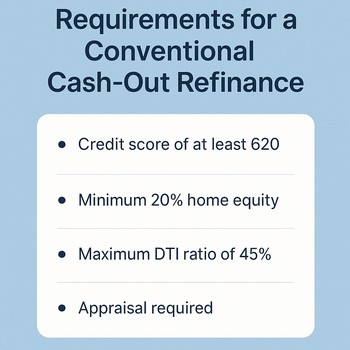 Conventional cash-out refinance limits are defined by two hard ceilings: the 80% loan-to-value (LTV) rule and your county's conforming loan limit. The 80% LTV cap means you can borrow no more than 80% of your home's appraised value, leaving at least 20% equity in the property. The conforming loan limit, set annually by the Federal Housing Finance Agency (FHFA), caps your total loan amount so it remains eligible for conventional conforming financing. Understanding how these two limits interact is essential to knowing exactly how much cash you can access.
Try our cash-out refinance calculator to estimate your maximum loan amount based on your home's value and current mortgage balance.
What Is the 80% LTV Limit for Conventional Cash-Out Refinances?
LTV stands for loan-to-value ratio. It's the percentage of your home's value that you're borrowing. For a conventional cash-out refinance, the maximum LTV is 80% for most primary residences.
Example: If your home is worth $400,000, the absolute maximum you can borrow with a conventional cash-out refinance is $320,000 (80% of $400,000). If your current mortgage balance is $250,000, you could access up to $70,000 in cash.
This 80% cap protects both you and the lender. It ensures you maintain significant equity, reducing the risk of negative amortization and making the loan less risky for the lender. In most cases, you cannot exceed this limit unless you qualify for specific exceptions, which are rare.
It's also worth noting that the 80% LTV rule applies to the total loan amount, not just the cash you receive. If your existing mortgage is $250,000 and you want $70,000 in cash, your new loan would be $320,000 — exactly 80% of the $400,000 home value. Any closing costs or fees rolled into the loan would push you over the limit, so you may need to pay those out of pocket or reduce your cash out.
Investment Properties & Second Homes: Lower LTV Limits
The 80% LTV cap applies to primary residences. However, investment properties and second homes have stricter limits. For these property types, the maximum LTV for a cash-out refinance is typically lower, often 70% to 75%. Lenders view these as riskier loans, so they require more equity to remain in the property.
For example, on a $400,000 investment property with a 75% LTV cap, the maximum loan amount would be $300,000. If your current mortgage balance is $200,000, you could access up to $100,000 — but you'd need to verify the property meets the lender's stricter qualification standards, which often include higher credit score minimums and larger cash reserves.
2026 Conforming Loan Limits: The Dollar Cap on Cash-Out Refinances
Beyond the 80% LTV rule, your cash-out refinance must also comply with the conforming loan limit for your county. These limits, set by the FHFA, determine the maximum loan size that Fannie Mae and Freddie Mac will purchase.
For 2026, the FHFA has increased conforming loan limits to reflect rising home prices. Here's what you need to know:
Baseline Limit for 2026
The standard baseline conforming loan limit for most U.S. counties is $806,500 for a single-family home. This is the maximum loan amount that qualifies for conventional conforming financing in most areas.
High-Cost Area Limits for 2026
In expensive housing markets, the conforming limit is higher. The high-cost area limit for 2026 is $1,209,750 for a single-family home. This applies to counties like Los Angeles, New York City, San Francisco, and Washington D.C. where median home prices significantly exceed the national average.
2026 Multi-Unit Property Limits
Properties with two to four units have higher loan limits to account for their increased value. The 2026 limits for multi-unit properties are:
- Duplex: $1,032,650 (baseline) / $1,548,950 (high-cost)
- Triplex: $1,247,950 (baseline) / $1,871,950 (high-cost)
- Fourplex: $1,550,250 (baseline) / $2,325,350 (high-cost)
How the 80% LTV and Conforming Limits Work Together
Your maximum conventional cash-out refinance amount is the lower of these two numbers:
- 80% of your home's appraised value (or lower for investment properties)
- Your county's conforming loan limit for a single-family home
Example 1: Home value: $1,000,000 in a high-cost county ($1,209,750 limit). 80% LTV = $800,000. Max loan = $800,000.
Example 2: Home value: $1,600,000 in the same county. 80% LTV = $1,280,000. County limit = $1,209,750. Max loan = $1,209,750.
In the second example, the conforming loan limit is the binding constraint. Even though 80% LTV would allow a $1,280,000 loan, the county limit caps it at $1,209,750. If you need more than that, you'd have to apply for a jumbo loan, which comes with stricter requirements.
Why 2026 Loan Limits Matter for Your Cash-Out Refinance
The annual increase in conforming loan limits directly affects your ability to access equity. Higher limits mean more homeowners can qualify for conventional conforming financing rather than being pushed into jumbo loans.
Conventional vs. Jumbo Loans
When your loan exceeds the conforming limit, it becomes a jumbo loan. Jumbo loans are still conventional but have stricter requirements:
- Credit scores: Jumbo loans typically require a 700+ credit score vs. 620+ for conforming loans
- Down payments: Jumbo loans often require 10%–20% down vs. as little as 3% for conforming
- Debt-to-income ratios: Jumbo loans cap DTI around 40%–43% vs. up to 50% for conforming
- Cash reserves: Jumbo loans demand significant post-closing reserves
By staying within conforming limits, you access lower rates, easier approvals, and more flexible terms. For homeowners in high-cost areas, the 2026 increase to $1,209,750 means more cash-out refinances can stay in conforming territory — potentially saving thousands of dollars in interest and fees over the life of the loan.
How to Calculate Your Maximum Cash-Out Amount
Follow these steps to estimate your cash-out potential:
- Determine your home's current value. Get a professional appraisal or use recent comparable sales.
- Calculate 80% LTV. Multiply your home's value by 0.80. This is your maximum loan amount based on LTV.
- Check your county's conforming limit. Visit the FHFA website or use Fannie Mae's lookup tool.
- Take the lower of the two numbers. This is your maximum cash-out loan amount.
- Subtract your current mortgage balance. The remainder is your potential cash-out amount.
Example Calculation:
- Home value: $500,000
- 80% LTV: $400,000
- County limit: $806,500
- Maximum loan amount: $400,000 (lower of the two)
- Current mortgage balance: $275,000
- Potential cash-out: $125,000
Keep in mind that the cash-out amount is not the same as the loan amount. The loan amount includes the cash you receive plus the balance of your existing mortgage plus any closing costs or fees rolled into the loan. If you want to maximize your cash out, consider paying closing costs separately if your budget allows.
Frequently Asked Questions (FAQ)
Can I borrow more than 80% LTV with a conventional cash-out refinance?
Generally, no. The standard maximum LTV for a conventional cash-out refinance on a primary residence is 80%. Exceptions are extremely rare and typically involve portfolio loans with much higher rates.
How do I find my county's conforming loan limit?
Visit the FHFA website's loan limit lookup tool or ask any mortgage lender. They can instantly check based on your property's ZIP code.
Do conforming limits apply to investment properties?
Yes, but investment properties have lower LTV limits (typically 70%–75%) and higher down payment requirements. Qualification standards are stricter than for primary residences.
Is PMI required on a conventional cash-out refinance?
Not if you're borrowing 80% or less. PMI (private mortgage insurance) is only required when the LTV exceeds 80%. Since cash-out refis are capped at 80%, PMI isn't typically required.
Can I use a cash-out refinance for any purpose?
Yes. You can use the cash for home improvements, debt consolidation, education expenses, or any other purpose. Lenders don't restrict how you use the proceeds.
Final Summary: Understanding Your Conventional Cash-Out Limits
To successfully access equity through a conventional cash-out refinance, you must navigate two key limits:
- The 80% LTV cap: You must leave at least 20% equity in your home.
- The conforming loan limit: Your total loan cannot exceed the 2026 FHFA limit for your county.
The 2026 increase in conforming limits ($806,500 baseline, $1,209,750 high-cost) expands access to conventional financing, allowing more homeowners to benefit from lower rates and flexible terms rather than being forced into stricter jumbo loans.
Before applying, use our cash-out refinance calculator to estimate your maximum loan amount and monthly payments. You can also review conforming loan limits for 2026 to confirm your county's cap, or explore conventional loan options to compare programs.
Connect With Us
Please share – it really helps