HomeReady Refinance in 2026: Requirements, Income Limits & Savings
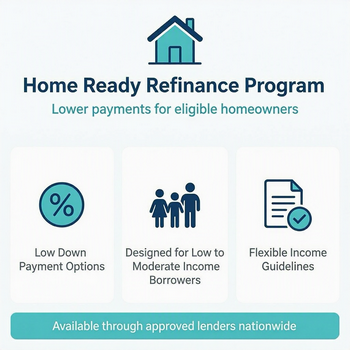 Are you a moderate-income homeowner struggling with high monthly mortgage payments? The Fannie Mae HomeReady refinance program could be the solution you need. Designed to make homeownership more affordable, this loan offers lower mortgage insurance premiums, flexible income rules, and competitive interest rates.
A HomeReady refinance is specifically crafted to help borrowers who may have limited income or modest credit scores. It allows you to replace your existing mortgage with a new one that has more favorable terms, ultimately lowering your monthly expenses.
What is a HomeReady Refinance and Who Benefits?
Simply put, a HomeReady refinance is a limited cash-out refinance backed by Fannie Mae. Its primary goals are to lower your monthly payment, reduce your interest rate, or shorten your loan term.
The program is ideal for you if:
- Your mortgage is currently owned by Fannie Mae.
- Your credit score is 620 or higher.
- Your household income is at or below 80% of the Area Median Income (AMI).
- You are looking to lower your mortgage insurance costs, which can be 25-50% less than standard conventional loans.
HomeReady Refinance Requirements for 2026
To qualify for a HomeReady refinance, you must meet specific guidelines set by Fannie Mae. Here are the key requirements:
1. Credit Score Minimum
You'll need a minimum credit score of 620. A higher score can help you avoid loan-level price adjustments and secure better rates.
2. Income Limit (80% AMI)
The most important requirement is that your total annual household income cannot exceed 80% of the Area Median Income for your county. Use the official Fannie Mae AMI lookup tool to check your eligibility.
A unique feature of the program is that you can count the income of non-borrower household members (like an adult child or parent) to help meet this limit, even though their income won't help you qualify for the loan amount.
3. Debt-to-Income (DTI) Ratio
Your total monthly debts should typically not exceed 45% to 50% of your gross monthly income. This includes your new mortgage payment, taxes, and insurance.
4. Existing Loan and Property
- Existing Mortgage: Your current mortgage must be owned or backed by Fannie Mae. Your lender will verify this.
- Property Type: The home must be your primary residence. Eligible properties include single-family homes, condos, townhouses, and 2- to 4-unit buildings.
- Conforming Limits: Your new loan amount must be under the conforming limit for your area ($806,500 for 2026).
- Max LTV: The loan-to-value ratio cannot exceed 97%.
Key Financial Benefits: Lower Mortgage Insurance
The primary draw of a HomeReady refinance is the significant savings on mortgage insurance. If your new loan is over 80% LTV, you will pay PMI, but at a much lower rate than standard conventional loans.
| Feature | Standard Conventional Loan | HomeReady Refinance |
|---|---|---|
| Minimum Credit Score | 660+ | 620 |
| Mortgage Insurance Cost | 0.55% – 1.0% | 0.25% – 0.50% |
| Max LTV for Refinance | 95% | 97% |
| Income Limit | No Limit | 80% AMI |
This reduction in PMI can result in hundreds of dollars in savings each year, making your monthly payment much more manageable. You can also cancel PMI entirely once your LTV reaches 80%.
How to Apply for a HomeReady Refinance
Ready to get started? Follow this step-by-step guide:
- 1. Check Your Eligibility: Verify your income against the 80% AMI limit using the Fannie Mae lookup tool.
- 2. Find a Participating Lender: Not all lenders offer this product. You can check with banks, credit unions, and mortgage brokers.
- 3. Gather Your Documents: You'll need pay stubs, tax returns, bank statements, and your current mortgage information.
- 4. Submit Your Application: Complete the application with your chosen lender and provide all necessary documents.
- 5. Underwriting and Closing: Your lender will order an appraisal, review your file, and provide a final approval. Then, you'll sign the closing documents.
To see how much you could save, try our Mortgage Payment Calculator to compare your current loan against a potential HomeReady refinance.
Common Questions About HomeReady Refinances
What if my current loan is not owned by Fannie Mae?
If your existing mortgage is not owned by Fannie Mae, you likely cannot do a limited cash-out HomeReady refinance. However, you may still be able to refinance into a standard conventional loan or another program, though without the same benefits.
Can I refinance if I have a late payment history?
Generally, the program requires a clean payment history, with no 30-day late payments in the last 12 months and no 60-day lates in the last 24 months. This is not a program for distressed borrowers.
What happens if the appraisal is lower than expected?
If the appraisal value is lower, your LTV will increase. To proceed, you would need to bring funds to closing to reduce the loan balance below the 97% LTV limit or look into a different refinance option.
Can I get a cash-out HomeReady refinance?
No. The HomeReady is a limited cash-out program. You cannot withdraw equity. The funds are solely used to pay off your existing mortgage and closing costs.
How long does a HomeReady refinance take?
From application to funding, it typically takes 30 to 45 days. This depends on your lender's workload, the appraisal, and how quickly you provide the necessary documents.
Are there any prepayment penalties?
HomeReady refinances typically have no prepayment penalty. You can pay off your loan early without cost. Confirm this with your lender before signing closing documents.
Is a HomeReady Refinance Right for You?
If you're a moderate-income homeowner with a Fannie Mae loan, a HomeReady refinance is one of the best ways to reduce your monthly expenses. The combination of lower mortgage insurance, flexible income rules, and competitive interest rates makes it a powerful tool for financial stability.
Contact a participating lender today to get a personalized rate quote and start your savings journey.
For more information, check out our guide on HomeReady Loans or compare it to the HomeReady vs HomePossible program.
Connect With Us
Please share – it really helps